

- Hungary
- Ireland
- Italy
- Malta, Republic of
- Portugal
-
Spain
-
Canary Islands
- El Hierro
- La Palma
- La Gomera
- Tenerife
- Gran Canaria
- Lanzarote
- Fuerteventura
- Tarajalejo
- Caleta de Fuste
- Corralejo
- Costa Calma
- Las Palmas de Gran Canaria
- Lobos Island
- Maspalomas
- Caleta de Famara
- Morro Jable
- Costa Teguise
- Jandía
- San Cristóbal de La Laguna
- Playa Blanca
- Playa de las Americas
- Puerto Calero
- Teide National Park
- Playa del Inglés
- Puerto del Carmen
- Los Realejos
- Puerto de Mogán
- Las Galletas
- La Orotava
- Anaga
- San Agustín
- Adeje
- San Bartolomé de Tirajana
- Puerto de la Cruz
- Los Cristianos
- Arrecife
- El Médano
- Orzola
- Masca
- Taurito
- Los Gigantes
- Fañabé
- Santa Cruz de Tenerife
- Santiago del Teide
- Garachico
- Punta del Hidalgo
- La Caleta
- Balearic Islands
-
Barcelona
-
Benalmádena
-
Cádiz
-
Córdoba
-
Jerez de la Frontera
-
Lleida
-
Málaga
-
Santander
-
Seville
-
Toledo
-
Canary Islands
Tinajo
Overview:
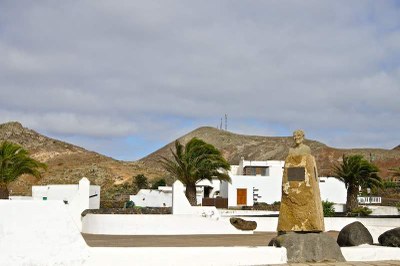
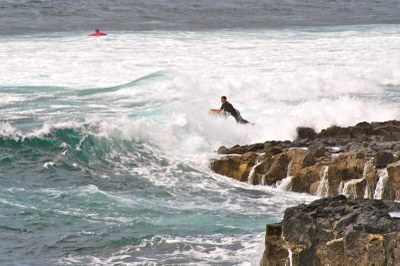
The main town in the region which shares its name, lying three miles from the west coast of Lanzarote island is the town of Tinajo. Throughout the region is a crust of solidified lava, a reminder of the volvanic activity on the island during the eighteenth century. Parque Nacional de Timanfaya (national park) is the most prominent tourist attraction of Lanzarote island. There are several beaches lazing along the coast of the region, such as La Santa, which is renowned as being one of the top spots in Europe for surfing, and indeed all water sports. This is where the La Santa sport resort is located. The north-east part of Tinajo attracts more and more tourists all the time, yet remains an unspoilt and authentic example of a Canarian municipality.
History
Tinajo was one of the last parts of the island to be invaded during the Spanish conquest in the 1490’s. Two hundred years later, the town was still sparsely populated, and it has been suggested that the population failed to increase at the time as it was under the rule of the infamously cruel and aptly named Ana the Vicious. The ruler was so strict and unfair on her people that many were discouraged from living there. From 1730-1736, several volcanic eruptions took place, which remain to this day the longest continuous eruptions ever recorded. According to legend, the present patron of the island, the Virgin de la Peña, was born in the sea of lava. It was said that during her presence, the flow of the lava stopped. Much of Tinajo, and the Mancha Blanca village in particular, spent many years blanketed in lava after the eruption. It was not until the 19th century that the town’s fortunes took a turn for the better. It was at this time that the area gained independence from the lands of Inaguaden, and became known as a municipality in its own right. Soon after, agriculture, and the export of the rich jable soil, became prominent in Tinajo. This had a positive effect on the area’s wealth and economy, and Tinajo has remained prosperous ever since.
Culture
Tinajo is famous for its Lucha Canaria wrestling tradition, and has one of the best teams on the island. The town has its own Terrero, a sand covered ring which forms a wrestling arena. This is located south of Tinajo, on the main road which comes from Mancha Blanca. Tinajo also plays host to beautiful religious art and architecture. A definate must see is the statue of Christ by Luján Pérez, the best-known and most productive sculptor of the Canaries.
Local crafts, using materials such as clay in particular, are a big part of Tinajo’s culture. Local artisians mostly make decorative crafts, and produce them by hand, using very little machinery in process. At the local market, you are likely to find quality items such as clay pots and vases, which have been made by Tinajo’s creative residents.
Religion
Tinajo is home to the Ermita de los Dolores, which is one of the most important churches on the island. Situated in the Mancha Blanca village, the church, and the catholic religion, has proved to be central to the community of Tinajo.
Economy
Traditionally, Tinajo has always been an agricultural town, and is one of the important zones on the island in terms of production. During the 19th century, Sandier jable soil was one the area’s main exports thanks to its suitability for growing crops, and this was once carried through the island on the backs of camels. Today, much of the area’s economy is based upon fruit and vegetable produce and livestock. This rural lifestyle is evident in the beautiful, rustic landscape, which comprises many picturesque farms. Thanks to the region’s agricultural prosperity, there are also many grand, luxurious houses, particularly in La Vegueta. In 2006, Tinajo began hosting a regular farmers' market, which takes place every Sunday from 10am - 2pm. The market is well worth a visit as it exhibits local produce at excellent prices. Since the 1960’s, the area has seen a steady growth in tourism without feeling the need to adapt its image in order to attract more people. Consequently, Tinajo provides a uniquely authentic atmosphere, compared to the more touristy areas on the island.
How to get there
By Bus:
From Arrecife, buses 15, 16, 52 and 53 stop by Tinajo on their way (12 times daily on weekdays, and less frequent on weekends) to La Santa.
By Car:
Hiring car is a convenient way to get to and around Tinajo. Finding Tinajo is easy, from Arrecife, simply follow the LZ-20, and the journey should take no more than half an hour. From Haría on the north, take LZ-10 southward before turning right onto LZ-30 at Teguise, then and right again onto LZ-20. From far south (Playa Blanca or Yaiza), follow LZ-2, followed by LZ-67. Last but not least the popular Parque Nacional de Timanfaya is less than 15 minutes drive south on LZ-67.
Sights:
Although the Parque Nacional de Timanfaya (national park) is the main attraction that draws visitors, there are a couple of magnificent churches worth visiting while in Tinajo. Religion is a prominent part of the municipality and it was greatly relied upon through the volcano eruptions.
Parque Nacional de Timanfaya (national park)
For more information on Timanfaya National Park, please click here.
Ermita de San Roque (church)
Located in the center of Tinajo, this white washed church was built in 1679, under the patronage of San Roque. The Moorish-style motifs, painted on the roof are one of the church’s most stunning features. The interior boasts ornate Tuscan columns, and the floor still comprises of the church’s original stone pavement. Outside, a sundial, an object which is essential to Canarian heritage, can be seen, and there is also a beautiful fountain here as well.
Address: Plaza de San Roque, 35560 Tinajo, Lanzarote island.
 Ermita de los Dolores (church)
The church is not only a stunning piece of white-washed architecture, but also has an interesting story behind it. Los Dolores church was constructed as a result of the 1736 volcanic eruptions. The residents of Mancha Blanca decided to go to the lava flow, which was heading in the direction of the village, in tow with the village priest who was carrying a statue of the virgin Dolores. The villagers promised that if the lava flow stopped, and didn’t cover Mancha Blanca, then they would build a church in honour of the virgin. The priest knocked a cross into the ground in front of the hot lava, and the people prayed. To their suprise, the lava flow stopped and failed to reach the farmland belonging to the village. Several decades later, in 1774, an old woman told a young 9 year old shepherdess, Juana, that the village should keep their promise and build the church, otherwise the eruptions would start again. When she told her parents and the inhabitants of the village, Juana was deemed a liar. After several more warnings from the elderly woman, the little girl decided to tell her parents once again, that the church must be built. This time, when she was telling them that she had seen the elderly woman again, they saw that their daughter had the mark of the Holy Virgin, a purple shadow of a hand, on her shoulder. Juana's parents took her to the local church, and the girl was shown images of various virgins. It had turned out that the elderly woman was in fact the Virgin de los Dolores. Consequently the villagers worked for ten years to build the church.
Address: Corner or Lugar Mancha Blanca and LZ-46, 35560 Tijano, Lanzarote island.
Dolores picnic area:
Located near the Los Dolores chapel, this space is used mainly for barbecues, and boasts several stoves, stone tables, sinks and even water and electricity. This is the perfect place to spend the evening and has plenty of space for children to play. There is even space to lay down several mattresses. You can rent the space for several nights and use it as a personal camp site. In order to do this, you must make a request, through the city council. It costs around 30 euro a day to rent the site, for this price you can have 30-50 guests at the site. A deposit of 150 euro must be paid in advance.
Activites:
Tinajo boast the popular Parque Nacional de Timanfaya, a nature playground for exploration and La Santa, one of the best spots to go surfing on the island. Alternatively, the Club La Santa sport resort has many facilities to accommodate those who are serious about sport.
Timanfaya National Park
The most popular tourist attraction in Lanzarote, Parque Nacional de Timanfaya is located at the famous Montaña de Fuego (mountain of fire) which once nearly destroyed the island. The area in which the park is situated, was once subjected to eruptions which took place continuously for 5 years. You can go on a coach tour, a walking tour, or even a camel riding tour of this magnificent volcanic wonderland. Alternatively, enjoy a meal grilled from geothermal heat rising out of the earth and watch the volcano demonstrations.
A well gripped, closed-toe shoe is essential should you opt to join one of the walking trails available. For more information on Timanfaya National Park, please click here.
Surfing and sports
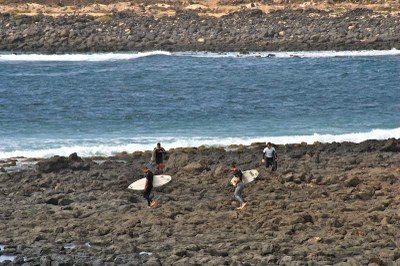
La Santa located on the coastline of Tinajo is famous for surfing and windsurfing alike. There is a sport resort, Club La Santa, offering over 30 types of sport activities for the sport enthusiasts. Personal trainers are available for those wanting to advance further with their training, and there is also a Wellness Centre for sport massage, spa and therapy. Please click here for more info.
Beaches:
Playa La Santa beach on the west coast is an ideal surfing spot. The sea lagoon at sport resort of Club La Santa is calm and suitable for windsurfing and other water activities.
La Santa Beach
La Santa is a scenic, white sandy beach, famed for being one of the best surfing spots in Europe. However, it is recommended that you don’t try and surf here if you are only a beginner, as the waves are very large, fast, and often difficult to catch. If you are a surfing novice, but would like to give it a try, it is best to go to the nearby Caleta de Caballo. There is also a stunning lagoon encircled and sheltered by the the small islet (Las Isleta), making it the perfect place to swim and try out windsurfing. Conveniently, there is a sports resort situated along the beach front, which offers lessons in everything from volleyball to windsurfing.
Festivals:
One of the main festivals in Tinajo is held in mid September in honour of the patron saint.
La Romeria de Los Dolores
La Romeria de Los Dolores is the most important festival in Tinajo municipality. The festival is celebrated on the 15th of September in commemoration of the Virgen de Los Dolores, the patron saint of Tinajo. On this day, around 50,000 islanders from all over, make pilgrimages to the stunning white washed church of the Mancha Blanca village, to take part in one of the most prominent and popular processions celebrated on the Canary Islands. During the procession, people gather to give thanks to the Virgin de Los Dolores (also known as “Lady of the Volcanoes”), for saving the village of Mancha Blanca, from being ravaged by volcanic eruptions.
Restaurants:
La Santa on the coast (5km north of Tinajo) boasts greater array of restaurants.
Restaurante El Tenique
Situated in Tiagua village (about 5km east of Tinajo), this restaurant offers authentic Canarian cuisine. It is particularly good for seafood, and papas arrugadas con mojo, a potato dish which is a local speciality. As it gets quite busy, booking in advance is recommended.
Address: Carretera Arrecife No. 100, Tiagua, 35560 Tinajo, Lanzarote island.
Telephone: +34 928 529 856
Restaurante Amêndoa
Here at Amêndoa you can enjoy freshly prepared cuisine in the stylish modern interior. The restaurant offers everything from local sea bass, to fresh salads and mouthwatering desserts. The menu even includes the rather aptly named "chocolate volcano", after the local volcanoes which dominate the region. Relaxing music is essential to the restaurant’s ambience, and is always playing in the background. Expect to pay around €25-€30 per person.
Address: Avenida El Marinero 20, 35560 La Santa, Lanzarote island.
Telephone: +34 928 838 252
Opening hours: Tuesday to Sunday 13:00 - 15:30 and 18:30 - 22:30, Monday 18:00 - 22:30
Restaurant Verde Mar
This restaurant with rustic dining room is located a short walk from the La Santa harbour. It serves international cuisine and fresh fish sourced from the harbour. This children friendly restaurant also serves tapas and a variety of food which is suitable for vegetarians, and those who require gluten and dairy free options.
Address: Señora Encarnación 2, 35560 La Santa, Tinajo, Lanzarote island.
(located on the Plaza/square of La Santa village)
Telephone: +34 630 152 860
Opening hours: Monday to Saturday from 12:00 noon
El Barquillo
Popular with the locals and fishermen, you will find this bar around the corner from Pro Bike, This small eateries serve excellent coffee, and a simple but tasty menu, with everything from bacon buttys to tapas.
Shopping
There is a grocery shop, a bakery, and a supermarket in Tinajo. Aside from these, there is not a great variety of shops. If you are looking for more of a variety, it is best to head to the capital, Arrecife, or Puerto del Carmen.
Mancha Blanca Market
This farmers market takes place on Sunday mornings from 09:00-14:00. It can be found in the centre of the Mancha Blanca village and is arranged in a U shape. Here, an array of goods can be bought, from agricultural produce to wine, and artisan products. On the last Sunday of the every month, the market stages its usual array of produce whilst additionally exhibiting different local traditions and customs.