

- Hungary
- Ireland
- Italy
- Malta, Republic of
- Portugal
-
Spain
-
Canary Islands
- El Hierro
- La Palma
- La Gomera
- Tenerife
- Gran Canaria
- Lanzarote
- Fuerteventura
- Tarajalejo
- Caleta de Fuste
- Corralejo
- Costa Calma
- Las Palmas de Gran Canaria
- Lobos Island
- Maspalomas
- Caleta de Famara
- Morro Jable
- Costa Teguise
- Jandía
- San Cristóbal de La Laguna
- Playa Blanca
- Playa de las Americas
- Puerto Calero
- Teide National Park
- Playa del Inglés
- Puerto del Carmen
- Los Realejos
- Puerto de Mogán
- Las Galletas
- La Orotava
- Anaga
- San Agustín
- Adeje
- San Bartolomé de Tirajana
- Puerto de la Cruz
- Los Cristianos
- Arrecife
- El Médano
- Orzola
- Masca
- Taurito
- Los Gigantes
- Fañabé
- Santa Cruz de Tenerife
- Santiago del Teide
- Garachico
- Punta del Hidalgo
- La Caleta
- Balearic Islands
-
Barcelona
-
Benalmádena
-
Cádiz
-
Córdoba
-
Jerez de la Frontera
-
Lleida
-
Málaga
-
Santander
-
Seville
-
Toledo
-
Canary Islands
Parque Nacional de Timanfaya
Overview:
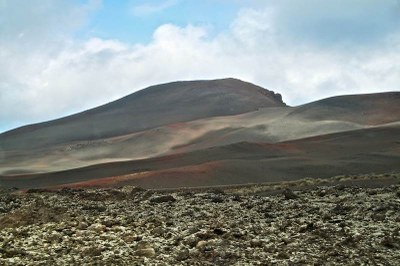 National Park of Timanfaya (Parque Nacional de Timanfaya) is the most popular tourist attraction in Lanzarote. Hundreds of thousands of people from all over the world visit this unique landscape every year. The temperature measured at 10 meters underground is very high reaching up to 600°C, with the mountains around the areas referred to as Montañas del Fuego (Mountains of Fire).
The National Park occupies an area of 51.07 km² in the southwest of the island. In order to protect the ecologically significant area, Timanfaya was declared a national park in 1974, and confirmed by law in 1981. A few years later in 1987 the autonomous Canarian Government passed the Natural Spaces Law which was officially enforced in 1994.
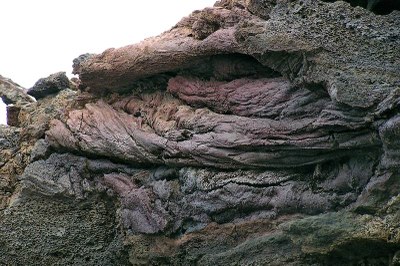
The entire park has volcanic origins and is still active. The eruptions which dated from 1730 to 1736 entombed the village of Timanfaya and covered the most fertile areas on the island. Within the area there are numerous sites of scientific and geological interest - as well as idyllic beauty. The destruction which was caused has resulted in some extraordinary features. Slabs of rock stand perpendicular to the horizon, having been forced there from numerous explosions. The Canary Islands are well known for having volcanic black sands however very few can be traced back to a specific incident such as this.
The most famous volcanoes in this area include:
the Montañas del Fuego (Fire Mountains), one of the island’s highest peaks, surrounded by 35 more volcanos and rich in nature (more than 300 desert adapted plants species have been found here).
la Caldera del Corazoncillo (Little Heart Cauldron)
the Montaña Rajada (Cracked Mountain).
Each volcano has a large magma chamber at its base, which fills up with gases and molten lava creating high pressure under which the material is forced upwards through the bedrock and erupts at the surface through a vent. The eruptions create new layers of volcanic material around the crater, leading to the volcano’s gradual expansion.
It is very unlikely that any of Lanzarote’s volcanoes will erupt in future without warning. Within the park the volcanoes are monitored by modern technological equipment which measures seismic activity. Also, there is no risk of a sudden gas cloud engulfing unsuspecting visitors. The lava streams which emerge from the volcanoes in Lanzarote are slow moving, giving lots of time to get out of their path.
Flora, fauna and formation
Very few animals managed to survive the environmental shift that the eruption created. The extreme heat, sparsity of flora, and continually harsh sunlight have made it difficult for animals to create a habitat here. The Atlantic Lizard has managed to adapt to the challenging geography and currently enjoy the privilege of having no natural predators. This has allowed the creature to not only continue to exist but also to thrive.
The flora around the volcanic area is rather unique. Throughout the Canary Islands there are approximately 1,000 species of plant-life that aren't found anywhere else in the world. Of these, 150 species can be discovered here in Timanfaya. The is due to the two separate climates being created in the wake of the eruption. The most obvious change was to the land covered or affected by the molten lava. For the patches untouched by the stream, little islets remained home to the flora that naturally occurred in the area. The most commonly grown plant is lichen. The versatility of it has meant that it too has flourished. Not only does this provide the animals food but it also helps to stabilise the environment for other plants to grow. Flowering plants such as hollyhocks are also seen across the landscape, especially along the slopes.
Lava trails are easily distinguished into the land and have significantly altered the region. The deep-running streams cut off sections which have now undertaken new roles. Some areas have become over-run with algae, others have been filled with volcanic sand. Caves have been hollowed out by hundreds of years of waves violently crashing into the shores.
How to get there
By Car:
From Arrecife, follow LZ-2 southward to Yaiza before turning right to LZ-67.
From Playa Blanca and Puerto del Carmen, take the LZ-2 to Yaiza. Follow signposts for Timanfaya and the LZ-67.
Alternatively you may visit through various organised tours departing from major cities within Lanzarote.
Timanfaya National Park opening hours:
Daily 09:00 - 19:00
Summer season 15th July to 15th September: 09:00- 17:45. Last visit on the volcano tour 17:00
If you are driving, it is recommended that you arrive between 09:00 to 10:30 or from 13:00 to closing time, when the park is less crowded.
Entrance fees:
Adult: €8 per adult including coach tour
Children between 7 and 12 years €4.
Sights:
The centre of visitors and Interpretation of Mancha Blanca
The centre helps visitors to understand the causes and consequences of the natural disaster through a variety of exhibitions. These exhibitions take visitors through the science of volcanic activity to the more personal effects of the eruption. Interactive screens help demonstrate how the community and the environment adapted to such a colossal shift in the environment. Some of the permanent features include a simulated volcano eruption and a geo-dynamic structure of the Earth.
The screening room within the centre showcases a documentary on life in Timanfaya before and after the event, along with four other audio-visual activities. A library full of Timanfaya-related books can also be found, with books on the subjects being available for purchase. Spectacular views can be seen from the panoramic balcony and the underground walkway which allows visitors to see volcanic flow. Parking is available for 57 cars.
This centre is the meeting place for many of the walking tours (see Activities).
Address: Carretera (LZ-67) Yaiza-Tinajo KM 9.6, 35560 Mancha Blanca, Tinajo, Lanzarote island.
Telephone: +34 928 118 042
Facsimile: +34 928 838 235
Opening Hours: 09:00 – 17:00 all year round.
Volcano demonstrations
There are various demonstrations performed outside the El Diablo restaurant, where staff pour water down a number of holes in the ground, which results in it burst back up in a geyser shape spout. Another demonstration shows how quickly hay will catch light when exposed to the heat emanating beneath the earth. Highly recommended.
Activites:
Visitors to Timanfaya are not permitted to walk or drive through the park unguided as the area is well protected, but there are several ways of exploring this amazing landscape.
Route of the Volcanoes (Bus Tour)
This bus tour is included in your entrance fee, so do not miss it. The 45 minutes bus tour covers a 14km drive reaching some of the most 'must-see' features of the park. The whole trip is spectacular with some places turning on hairpin bends and assailing the flanks of the highest volcano of Santa Catalina. The coach drivers stop at numerous points along the route so that visitors can admire the beauty of Timanfaya properly and take some photos. The journey is accompanied by commentaries in English, Spanish and German. Some of the highlights on this route are “Manto de la Virgin” (the Virgin's Mantel) which contains volcanic tubes made from very fluid and viscous lava flows, and “Valle de la Tranquilidad” (Valley of Tranquillity).
Adult: the €8 entrance fee paid includes the coach tour
Children (7 and 12 years): the €4 entrance fee paid includes the coach tour
Last bus tour: 17:00
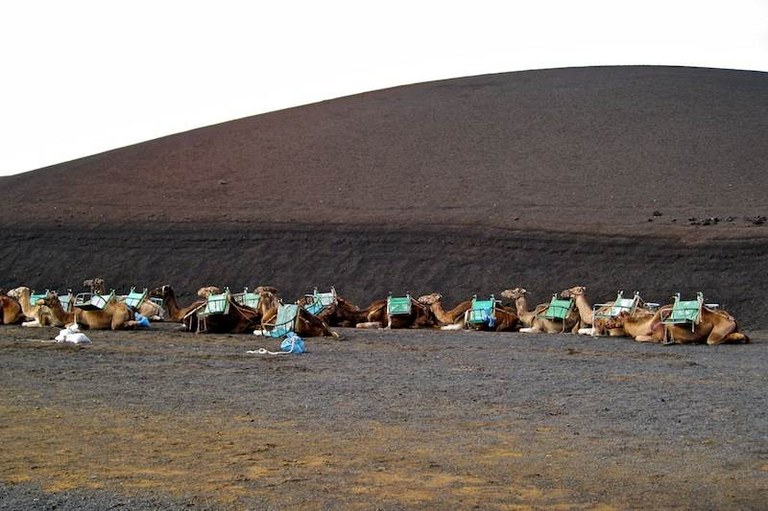
Camel riding at Timanfaya
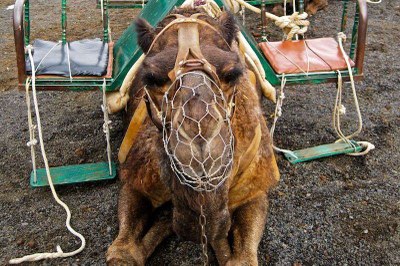
The Echadero de las Camellos marks the starting point to the south slope of Timanfaya, and the beginning of an exciting camel ride. Lasting around 20 minutes the tour is an interesting way of showing visitors the historical mode of transport on this volcano landscape. The camels carry one person on each side therefore it is possible to experience the journey with a friend or a family member. No advanced booking is needed.
While waiting for the camel ride, why not visit the museum/information centre located within the Echadero de las Camellos area? Here you will learn about the traditional farming tools used by the local farmers and how camels were once an important transportation for the people of the island.
Opening hours: Daily 09:00 - 16:30, closes 30 minutes earlier in the winter.
Last ride: 30 minutes before closing time.
Cost: €10 for a camel with 2 seats
Guided walk
It is possible to visit the park on foot. Two free guided routes are departing Mancha Blanca’s Visitors & Interpretative Centre, and available in English.
Termesana Route
This route provides you with the closest you will get to the actual volcano. The 3km route helps visitors to understand how the local people adapted to life during the eruptions of 1730-1736. It also highlights how traditional culture of Lanzarote played a part during the years of the catastrophe. The tour can be booked online up to 2 months ahead of your vacation, via http://www.reservasparquesnacionales.es
The tour is delivered in English and can be for a group of up to 8 people. The meeting point is the Mancha Blanca Visitor Centre 15 minutes before your allotted time. It will take around 3 hours to complete the tour but don't worry it is not physically demanding terrain that you will be walking over. Unfortunately children aren't allowed and the minimum age is 16, and 16 and 17 year-olds must be accompanied by adults. Comfortable clothing and closed footwear must be worn at all times. Some sort of ID should be shown at the meeting place for all members of the tour. The service maybe cancelled at any time due to adverse weather.
Coastal Route
When hot lava met the seawater new land was created – and this is where the coastal tour takes place. This more demanding, but more intimate walk will take you to the areas which have been able to blossom after the eruption. The tour can be booked online up to 2 months ahead of your vacation, via http://www.reservasparquesnacionales.es
The tour is also delivered in English and can be for a group of up to 7 people. The meeting point is the Mancha Blanca Visitor Centre 15 minutes before your allotted time. It will take around 6 hours to complete the tour and the trail is very physically demanding. The route will take you across 9km of coast so a water bottle is mandatory, as is food. Unfortunately children aren't allowed and the minimum age is 16, with 16 and 17 year olds being accompanied by adults. Hiking boots or trekking shoes must be worn. Some sort of ID should be shown at the meeting place for all members of the tour. The service maybe cancelled at any time due to adverse weather.